Before the Suggestion Box: How Residents Shared Local Concerns
Before online forms, neighborhood petitions gave residents a shared way to raise local concerns. See what they could convey and what a signature left out.
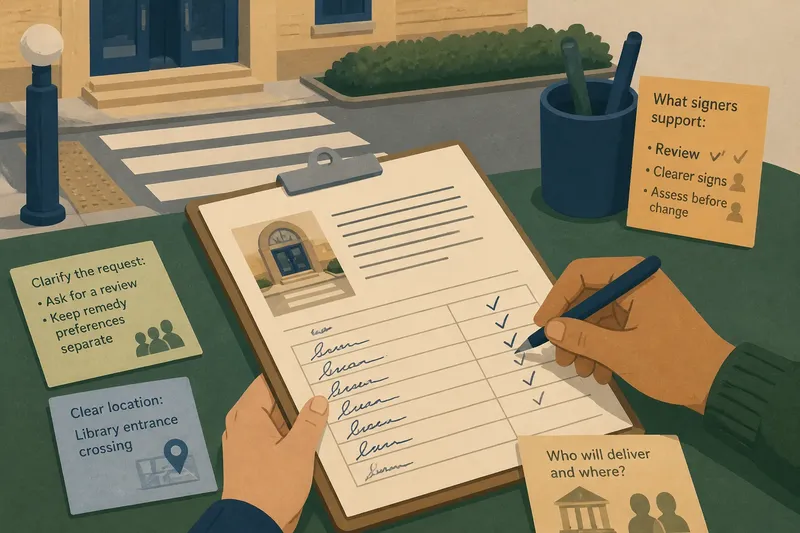
The common mistake in discussing neighborhood petitions is to treat a signed page as a complete account of a local concern. A petition could gather support for a request, but its brief wording often left out the details needed to understand the issue. Its value lay in making a shared request visible, not in speaking for everyone affected.
What could a neighborhood petition show?
A petition put a request into a form that neighbors could read, discuss, and sign. Someone had to decide what the concern was and what change to ask for. That act of editing mattered: a page could make a request easier to grasp while leaving some experiences outside its wording.
A petition’s signatures indicated that the named people supported the request. They did not explain why each person supported it, establish how broadly the concern was shared, or settle whether the proposed remedy would work. Those questions required context beyond the page.
Imagine a tenant in an invented situation who wants the city to review a crossing near a library entrance. She writes a petition asking for a review, identifies the crossing by its nearby entrance, and asks neighbors who use the route to read the wording before signing. One neighbor supports the review but prefers clearer signs; another wants the crossing assessed before any change is proposed. The resulting petition shows support for a review, while their differing preferences remain useful context rather than being collapsed into a claim of agreement on a remedy.
How did local petitions take shape?
There was no single route by which residents raised concerns across all places and periods. The available options depended on local institutions and circumstances. A petition could circulate among people who shared a building, street, or concern, then be delivered to a landlord, public office, or other recipient. Its path and influence varied; the paper alone did not decide what happened next.
That variation is why a petition is best understood as a record of a request and its signers, not a full history of neighborhood participation. It may capture one moment of agreement. It usually cannot show who did not see it, who chose not to sign, or what other views were expressed.
What details make a petition easier to understand?
A petition benefits from a recognizable location and a request its recipient can identify. Vague wording such as “fix the neighborhood” gives little direction. A request to review a named crossing, explain a service decision, or consider a specific change gives readers a clearer subject to assess.
- Check the request: If it names a specific action, keep that wording; if it bundles several unrelated demands, separate them or choose the main request.
- Check the location: If a recipient could identify the place from the description, retain it; if not, add a nearby intersection, entrance, or landmark.
- Check what signers support: If the page distinguishes support for review from support for a particular remedy, preserve that distinction; if not, revise the wording before asking for signatures.
- Check who will receive it: If the recipient is named and connected to the request, direct the petition there; if not, ask a local information desk or relevant office where it belongs.
- Check how it will be delivered: If someone has agreed to deliver it and share the response, record that plan; if not, decide who will take responsibility before collecting more signatures.
- Check whether signers can keep a copy: If they can, share the final wording and delivery details; if they cannot, provide a clear account of the request and recipient.
These checks do not make a petition speak for people who did not sign. They help prevent confusion about what signers actually asked for and where the request is going.
What did petitions leave out?
A short petition could not easily hold every reason, qualification, or disagreement behind a signature. A signer might support a review without endorsing a proposed fix. Another resident might be affected but unavailable to read the page. The document records the choice to sign, not the full range of views in a neighborhood.
For that reason, it is useful to distinguish the petition’s direct claim from any broader interpretation. “These named residents request a review” describes what the document shows. “Everyone in the area wants this change” goes further and needs a basis the signatures may not provide.
How should a petition be carried into a city decision?
A petition is a statement of resident support, not necessarily a service report or a formal application. The next route depends on what is being requested and how the relevant city or organization handles such requests. A city information line or service desk can help identify the right office when the recipient is unclear.
When delivering a petition, preserve its exact request and note who received it. If the office supplies a confirmation or referral, keep that with a copy of the submitted page. If the petition is redirected, the copy helps explain what signers originally supported; it does not require the new recipient to accept the proposed remedy.
What do residents ask about neighborhood petitions?
Does a petition prove that a whole neighborhood agrees?
No. It records support from the people who signed, not from everyone who lives nearby or uses the place. Describe the signers’ request without extending it to people whose views are unknown.
Should a petition demand a remedy or ask for a review?
That depends on what signers have agreed to support and what the recipient can address. If people agree that a condition needs examination but differ on the fix, asking for a review keeps those positions distinct.
What should happen if a recipient says the petition belongs elsewhere?
Ask which office or process handles the request, then keep a record of the referral. If the new route changes what the petition asks for, explain that difference to signers rather than silently changing the request.
Can a petition include disagreement among signers?
It can state the shared request while recording different preferences separately. That approach avoids presenting support for one common action as agreement on every possible outcome.
What can a petition contribute to a local decision?
A neighborhood petition can make a request and its signers visible to a recipient. Its limits are just as important: signatures do not establish universal agreement, supply every relevant detail, or determine the right response. A careful account says exactly what the page represents.
When preparing a neighborhood petition, keep a copy of the final wording and note its recipient. That small record gives signers a clear reference if the request is redirected or discussed later, while leaving room for the decision-maker to assess the issue on its own terms.